In May 1941, in the port city of Galaţi, near the southernmost tip of Moldova, Eti Feldstein was born into a world collapsing. Big brother “Soli” quickly nicknamed her “Coca” after one of his toys – a term of endearment that lasted a lifetime.
For centuries, the Jews of Galaţi had thrived as the heartbeat of the city’s commerce. Eti’s father, Manase, was a successful accountant, part of a sprawling, vibrant family where seven brothers shared a single courtyard in a Jewish neighborhood. But the walls of that courtyard could not keep the world out. When Romania allied with the Axis powers in September 1940, the city’s Jewish population was transformed from citizens into outcasts overnight.
Under the new radical right-wing government of General Ion Antonescu, Romania joined with the German invasion of the Soviet Union in June 1941. But for the Jews who were not permitted to join the military, persecutions raged.
In Galaţi and neighboring villages, the police gathered all the Jewish men age 18-60 in the local movie theater for two days, and in the mornings, they were forced to sweep the streets. Movement in the city was restricted. The Jews were treated like outcasts and were not allowed any ties with the regular population. On the third day, the men were moved 4 km out of the city, to the village of Fileşti, where a holding camp guarded by gendarmes was created.
On July 2, 1941, the internees at the holding camp in Fileşti were moved to 19 makeshift camps in Galaţi, ranging from synagogues and Jewish schools to private houses. Although each holding site carried the name “camp” (lagăr), each was actually a subcamp of the Galaţi camp.
Eti’s memories came solely from the little her parents spoke of how their home became part of that camp. She recalled her father, Manase, leaving the house and going to work for 2-3 months at a time, doing construction work somewhere in Romania. Her mother, Klara, was home by herself with two small children. A grainy photo of Eti as a baby in her parents’ arms with a yellow Star of David sewn on her clothing bears witness to her stolen childhood.
While the family survived on Klara’s wits and her ability to translate for the occupying Germans, the Holocaust claimed the rest of their world. Eti’s grandparents were deported to camps and ghettos in Transnistria; only her maternal grandmother returned, carrying stories of a landscape defined by exposure, starvation, disease, and death.
The Galaţi camp closed in December 1941, when all the forced laborers were released from the subcamps. Well- to-do Jews were then held hostage by the police and would be shot if any Jews fled the city or obstructed forced labor plans. Forced labor in the interior (sleeping at home) and exterior brigades began again in the spring of 1942 and continued until August 1944, when Romania joined the Allies, fighting alongside the Red Army against the Germans for the duration of the war.
Retreating German forces set the Jewish quarters ablaze, and the largest synagogue was burned along with several prayer houses and orthodox schools. Allied bombs reduced the Feldstein home to rubble. But Eti, viewing the world through the resilient eyes of a child, didn’t see horror. She saw the skeletal remains of buildings as a new playground, a strange and shifting landscape that was simply “life.”
The post-war years brought a new shadow: Communism. Romania had the largest Jewish population in the region, but many decided to emigrate. Others welcomed the Russians as liberators from Nazi fascism. For those not of the Jewish faith, communism was not welcome, creating a societal rift.
In 1945, Eti and her family moved to Bucharest where Manase had a distant relative who owned a factory. He worked as an accountant, and the Feldsteins lived in a house at the factory. Eti attended school for the first time, a religious school in Bucharest. After a year, she transferred to a Romanian school, ultimately completing nursing school and specializing in radiation oncology with a career of service that spanned four decades.
Yet, even as she excelled, Eti felt the “glass ceiling” of Romanian society. “All my life, I feel I be a Jew. I not be the same like the others,” she would later recall. She watched top honors go to her Romanian peers, accepting with a bittersweet grace that some paths were closed to her. “And so I understand that everything is not for me.” “But I be happy so.”
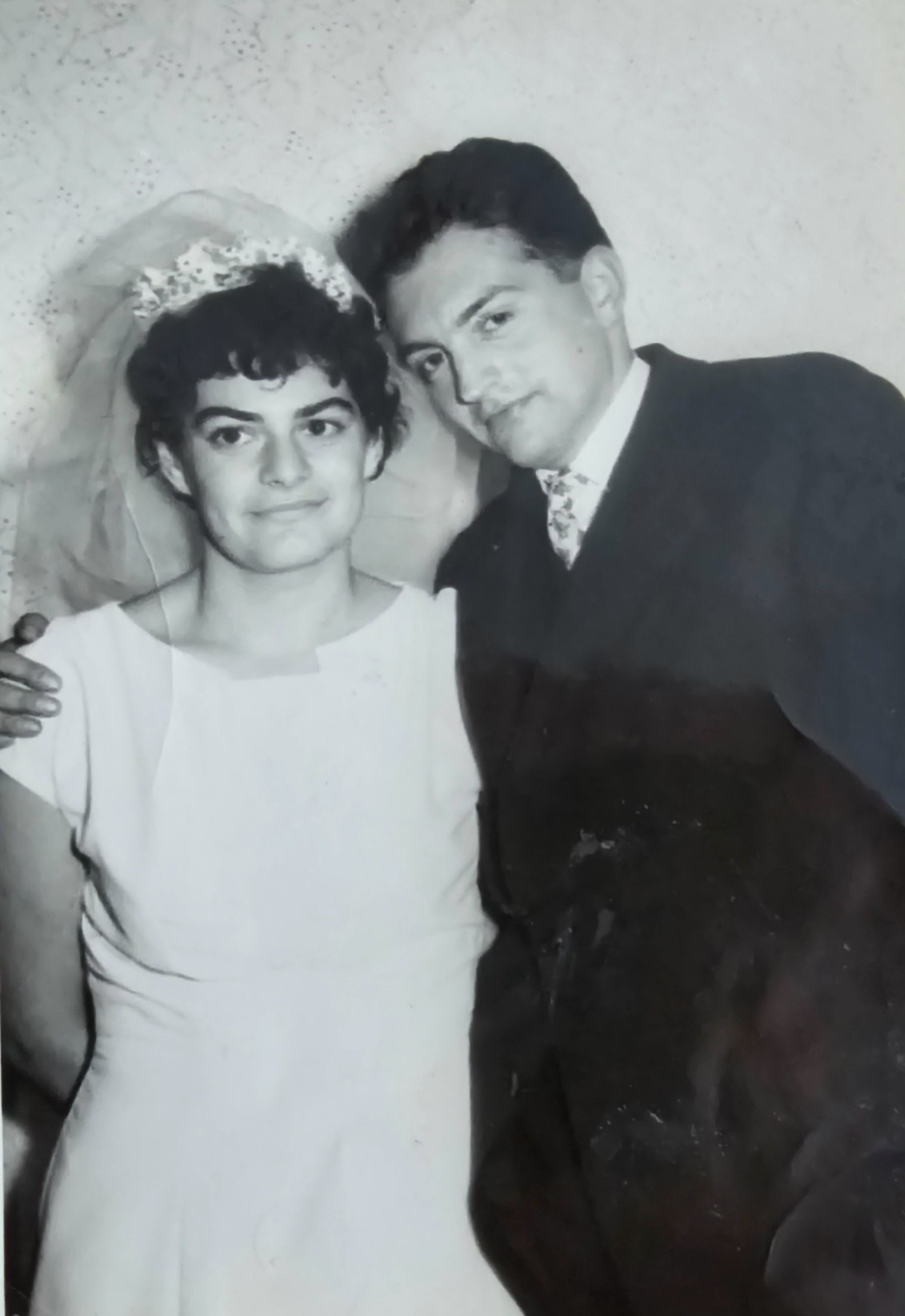
Eti met her future husband, Izaia Schächter, through tradition – a matchmaker arranged by her grandmother. Izaia was an accountant like her father. After only 7 “dates,” Eti and Izaia were married in Bucharest in 1964, a union that would anchor her for 58 years.
Their only son, Armand, was born in1969. Although Romania was still under communist control, young Armand was able to attend a religious school and become a bar mitzvah. He went on to attend a prestigious German school in Bucharest and received his medical degree in 1993.
With the fall of communism in 1989, Eti and Izaia were able to travel freely, but their son recognized limited advancement opportunities for a Jew in Romania and took his medical residency in New York. In 2018, Eti and Izaia retired and immigrated to Birmingham, Alabama, to be near Armand, now a practicing psychiatrist. They found peace in a place where being “different” no longer meant being in danger.
Eti Schächter passed away after a long battle with metastatic cancer surrounded by the family she had protected. She was a force of nature, who had propelled her only son to an improbable future.
Click on any image below to enlarge and view captions.
All photos on this website are the property of the Alabama Holocaust Education Center archive. Please contact us for permission before using or sharing any images.
05/21/1941
Galaţi
Klara Meer
(11/12/1912 Bukovina – 1976 Bucharest, Romania)
Manase Feldstein
(05/12/1894 Galaţi, Romania – 1994 Batyam, Israel)
Israel “Soli” Feldstein
(09/1937 Galaţi, Romania – 2019 Hadera, Israel)
Armand Sorin Schachter (Spouse: Susanne Seaborn)
(08/14/1969 Bucharest, Romania – )
2018-2023
Galaţi, Romania
(July 1941-August 1944)
Eti’s paternal grandfather and maternal grandparents were deported to Transnistria. Only her maternal grandmother survived.
Armand Schächter (son)
2018-2023